
| Category | Terrestre |
| Date | 1997-2024 |
| Investment | 66.310,00$ |
Thanks to LPF’s conservation efforts, the Black-cheeked Lovebird has been saved from extinction. Although their populations are currently fragmented, their numbers are increasing, which gives even more hope to this parakeet.
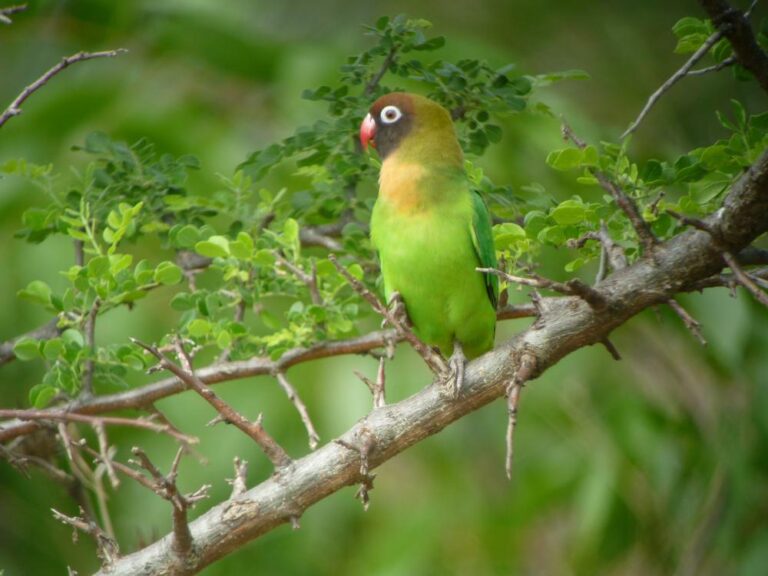
Black-cheeked Lovebird, Zambia
The black-cheeked lovebird (Agapornis nigrigenis), a bird endemic to Zambia, is associated with mopane woodlands and relies on seasonal ponds and surface water sources. It is currently listed as Vulnerable by the International Union for Conservation of Nature (IUCN), due to a combination of past trapping for the pet trade, ongoing habitat loss and drying, shifts in traditional agriculture that reduced food availability, and decreasing water access—further worsened by climate change.

To reverse this trend, Loro Parque Fundación supports a comprehensive research and conservation project. Key actions include accurately mapping the species’ distribution and population size, identifying limiting factors such as habitat quality, nesting trees, water sources, and human pressures, and monitoring water use patterns over time and space through citizen science and remote sensing.
The project also models future habitat and water availability scenarios. These findings are used to guide long-term management strategies aimed at securing the future of a species highly dependent on water during the dry season.