

| Category | Completed |
| Date | – |
| Investment | 173.534$ |
As a leader in Psittacidae breeding in controlled environments, LPF strives for scientific progress in this area, which is key to the survival of many endangered species.
Back
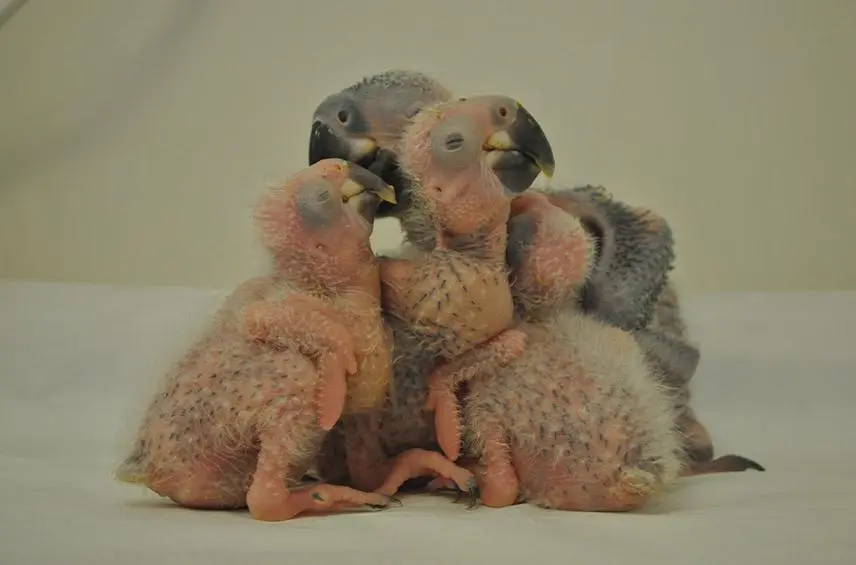
Artificial insemination in psittacine species: sperm collection, evaluation, and transfer
Many parrot species are threatened due to habitat destruction, poaching and other pressures. An important conservation tool is breeding under human care, to maintain genetic material and for subsequent release into the wild. Some species, such as the Spix’s Macaw (Cyanopsitta spixii) are deemed extinct in the wild, and only a small population exists under human care. These individuals have to be paired and cannot choose their own partner, resulting in eggs that are often infertile. Male infertility is also a common problem, but these disadvantages can be overcome by artificial insemination. It is also very common for captive populations to have more females than males. This allows us to pair these females with sterilised males of other species, so that they can develop their courtship and mating behaviour naturally, but artificially inseminate them with sperm of their own species.
Although semen collection and artificial insemination are regularly and successfully used to generate large numbers of fertile eggs in raptors or turkeys, sperm collection has rarely been described in small psittacines. Furthermore, it has not been possible to date to collect semen in larger species. Therefore, little data exists on parrot semen, and more information is needed to obtain baseline data for future research on male infertility, artificial insemination, and cryopreservation, as well as to establish a standard technique for artificial insemination.
In the previous phase of this project, which has already been completed, semen collection in more than 100 species of large psittacine birds and subsequent artificial insemination was successfully achieved. The next goal focuses on establishing a method for semen preservation by freezing.
BLOG
News

A workshop held at Loro Parque Fundación by the Macaronesia Species Survival Centre, together with…

The award ceremony will take place on January 14 at Poema del Mar aquarium, attended…
A study carried out within the framework of more than 20 years of scientific collaboration…
Nature reserves are true treasures of biodiversity, playing a crucial role in the protection of…